
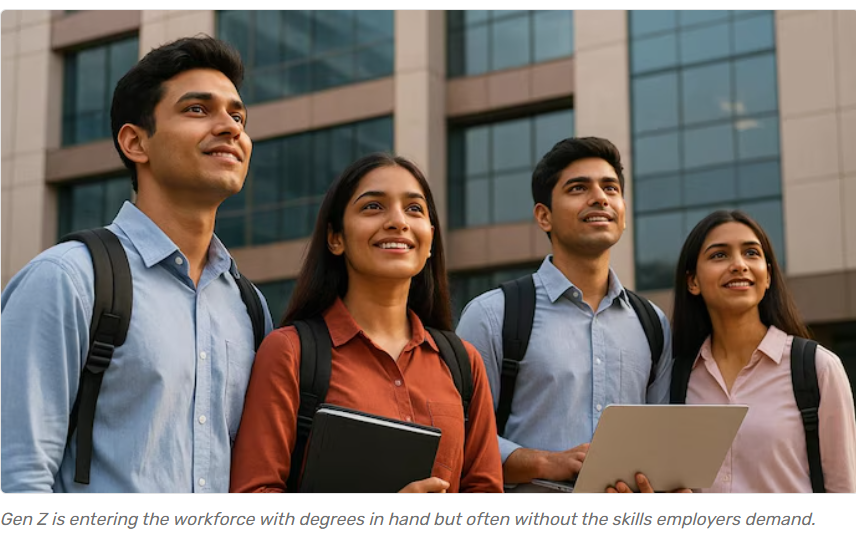
Every summer, Indian colleges send millions of degree-holding graduates into the market. The season should mark the beginning of working life. For most, though, it is the beginning of a battle. Employers complain that new recruits are ‘not workplace-ready’. Graduates themselves feel not ready to deal with reality beyond the books.
This divergence, between education and employability, has been one of India’s biggest problems as well as a challenge.
In recent years, corporates and higher education institutions have been trying to rise to the challenge with internships, industry partnerships, and courses based on employment.
The reason is apparent. Internships expose students to deadlines, client interaction, hierarchical collaboration, and accountability at work.
A late project at college may be accepted; the same tardiness at a company can spill over into a chain of operations.
This is an early indoctrination that habituates students to take responsibility before they embark on full-time work.
But there is still trouble. Far too many internships are little more than clerical duties, photocopying, or low-stakes activities that provide no real learning.
Experts say that if institutions and employers come together to co-design formal internship programs with explicit learning outcomes, the exercise will become a ritual.
How long is important, but so too is the quality of exposure.
“From the point of view of Gen Z, employability is not just about degrees anymore. Industry collaborations and internships provide them with hands-on experience, confidence, and career direction, while keeping the colleges relevant and the companies influencing future talent. It’s a win-win environment,” opines Kalpesh Banker, Managing Partner, EduShine Search Partner.

INDUSTRY-DRIVEN CURRICULA
Another interesting trend is corporate – university course co-design. OP Jindal Global University’s Co-op Bachelor’s Degree, which was co-designed with upGrad, is one such example.
It has a full year of industry exposure integrated as part of undergraduate education.
Instead of considering classrooms and workplaces as two separate silos, the program integrates them in such a manner that students are not only equipped with academic knowledge but also corporate practical knowledge.
Corporates benefit, too. They create a future workforce familiar with their processes, technologies, and culture through curriculum shaping. And students get nearer to employment, acquiring skills that meet demand.
Such arrangements are a departure from outdated syllabi that lag behind industry developments.
THE ROLE OF LIVE PROJECTS AND MENTORSHIP
Theory classroom has only so much of a shelf life in an economy which is being re-shaped by automation, AI and evolving business models.
The colleges are now experimenting with live projects, mentorship, and case study pedagogy.
“Education needs to stop working in silos and must develop as a collaborative ecosystem where institutions, businesses, and policymakers align to create future career paths so that students acquire knowledge and learn-by-doing skills to be completely job-ready,” states Akshal Agarwal, Co-founder of Nature Nurture.
These approaches force students to address real business problems rather than theoretical ones.
Case studies expose students to compromise in decision-making.
The gap between academia and industry remains a major challenge, as it not only creates a divide but also, without proper collaboration between the two, leads to a lack of industry experience.
“Another gap is the limited interaction between academia and industry experts,” say Sonica Aron, founder & Managing partner, Marching Sheep.
“Many colleges invite speakers occasionally, but the intent is around placements rather than exposure. What students need is frequent and candid conversations with professionals from different industries and functions, leaders who can share not just their successes but also their struggles, the changing nature of businesses, and what qualities help people succeed today,” adds Sonica.
Mentorship introduces them to real-life industry anecdotes, success, failures, and insights that won’t be read about in textbooks.

GEN Z’S PRAGMATIC LEANING
Unlike earlier generations, Gen Z is results-oriented. This generation wants assurance on how education translates to career progression. Industry-recognised certifications are therefore required.