
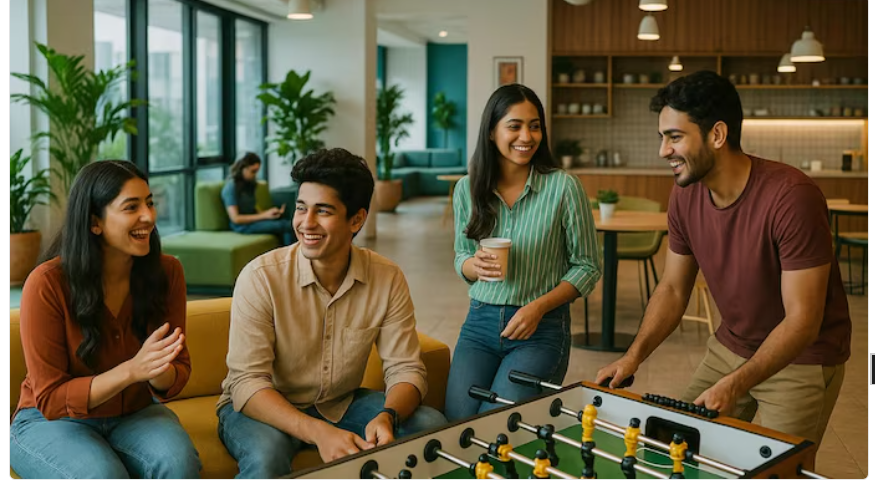
Work, as we knew it ten years ago, has been transformed beyond recognition. The factory-bell culture, strict hierarchies, and the ‘chair time’ mentality no longer define the contemporary workforce. Today, business corporations are at the centre of a reset. Workers no longer see jobs merely as a source of income; they seek respect, belonging, and growth.
Gen Z is playing a major role in redrawing the boundaries of workplaces. From relaxed dress codes to games, activities, and team-building sessions, the new setu
PAYCHECKS AREN’T THE CASE ANY MORE
In most boardrooms, retention has replaced recruitment as the buzzword. The question is no longer how much to pay, but how to keep people engaged.
Maveric Systems’ Vice President – Human Resources Krishnakumar Ramachandran states it succinctly: “Rather than a paycheck, associates today demand respect, freedom, and possibilities for lifelong learning as an integral part of their daily job.”
That need is informing policy. Frequent check-ins, flexible hours, peer learning circles, and mentorship programs are going mainstream.
Firms once viewed culture as a vague idea now recognise it as a direct productivity driver. “A flat org structure increases visibility, recognition, and empowers associates to innovate,” Ramachandran says.
“For us, the workplace shouldn’t be a pressure cooker for the brain. It has to be a space where we can collaborate, learn, and actually enjoy being there. Flexible hours, chilling zones, even game zones matter because they keep us engaged and creative,” says **Priyanka, 24, a Bengaluru tech startup employee.
“Startups in Bengaluru are showing how this can work, where seniors don’t pressurise with hierarchy but step in to guide and help. That’s the kind of workplace we want everywhere,” she adds.
THE GENERATIONAL LENS
Generational shifts are sharpening these changes. Gen Z, now entering the workforce in large numbers, demands authenticity. They want to see values lived, not just written. Millennials, scarred by overwork in their early careers, want balance and growth.
On whether there are generational differences in what employees expect from workplace culture, Sonica Aron, Founder & Managing Partner at Marching Sheep, says, “Absolutely. Gen Z seeks authenticity and purpose; they want to work where values aren’t just spoken but lived. Millennials often balance ambition with wellbeing, craving flexibility and growth”.
The test of leadership is to create cultures that are responsive. “The key isn’t to generalise, but to listen,” Ramachandran emphasises.
Culture cannot be petrified in tradition. It has to evolve with the needs of employees, influenced by life stages and social change.
“Gen X, having weathered rigid systems, values stability but increasingly seeks meaning. Each generation brings its own lens, shaped by life stage and societal shifts. The key isn’t to generalise, but to listen. Culture must be adaptive, responsive to evolving needs, not fixed in tradition,” says Sonica.

CULTURE AS AN INVISIBLE THREAD
Retention has become the point of concern for HR leaders. The statistics are speaking: attrition surges not just when pay is low but when employees do not feel seen.
Ramachandran makes a hard line: “Retention isn’t solved by perks; it’s built through empathy, fairness, and purpose.”
This is where culture is the unwritten rule. A good workplace isn’t required to command loyalty; it builds it day by providing safety and belonging.
Psychological safety teams excel and surpass other teams not for working longer hours, but for working with trust.
Women coming back after maternity leaves, new employees wanting to learn from others, or seasoned workers asking for flexibility, all perform well in places where dignity is upheld.
The price of doing this wrong is on full display everywhere. Burnout, disengagement, and high turnover are no longer anomalies; they are structural.
Employees are not leaving just for higher pay overseas or with rivals; they leave because compassion becomes too expensive. “Burnout doesn’t result from hard work but from feeling invisible while working hard,” Ramachandran says.
THE UNEVEN MAP OF INDIAN WORKPLACES
But the change is uneven. Indian offices remain divided between the new and the old. In one corner, startups boast inclusive policies, open offices, and cross-functional teams.
In another, legacy companies still reward presenteeism, impose strict hours, and operate on approval chains based on hierarchies. Ramachandran refers to this as a “pocketed evolution.”
There are encouraging indications–leaders hearing more, mental well-being gaining ground in conversations, women returning to the workforce with dignity–yet bias, fear, and silence persist.
Culture, as he describes it, is not in policy guides but in “how people feel every day.”
An inclusion poster is meaningless if a disabled person cannot use the office bathroom, or if a returning mother comes back to work without adequate assistance.
This is where most businesses falter–in the difference between what they say and how they live.

STARTUPS ACTING AS LABORATORIES
Notice how startups have emerged as the innovation labs of new ways of working. Equity-based incentives, no-designation models, and flexible leave systems are upending the old contract of employment.
Startups wager on autonomy and innovation, building ecosystems where taking risks pays. This is the natural habitat for many millennials and Gen Z workers–fast, agile, and values-driven.
But startups also expose the constraints of experimentation. Burnout is epidemic, and absence of structure usually creates chaos.
The takeaway for larger companies is to steal the agility but complement it with sustainability. Practically, it is a matter of integrating autonomy with support, flexibility with accountability.
Startups have demonstrated what flexibility and purpose models can do, but they also show the dangers of excess. The sweet spot is to craft workplaces that are both agile and caring, both demanding and dignified.
As businesses re-draw their maps, one reality is clear: culture is not an afterthought, it’s the job. The businesses which understand this sooner rather than later will not only survive disruptions but flourish in them.