
Every June, brands across the world flood advertising channels with rainbow-coloured logos, Pride-themed campaigns and declarations of solidarity with the LGBTQIA+ community. But as consumers become more informed and corporate behaviour more transparent, the gap between what companies say and what they actually do is coming under unprecedented scrutiny.
What was once viewed as a progressive marketing gesture is increasingly being questioned as performative allyship. Consumers, employees and advocacy groups are no longer judging brands solely by the visibility of their Pride campaigns, but by the policies, investments and leadership decisions that exist behind them. In an era where brand purpose is expected to be measurable rather than symbolic, rainbow-washing—the practice of leveraging LGBTQIA+ imagery without meaningful organisational commitment—has evolved from a reputational risk into a business liability.
For companies, the challenge extends far beyond changing logos for 30 days in June. The real test lies in whether inclusion is embedded into hiring practices, employee benefits, supplier ecosystems, leadership representation and long-term community investment. As stakeholder expectations rise, authentic allyship is increasingly emerging as a marker of corporate credibility, while superficial Pride marketing risks eroding consumer trust, employee confidence and brand equity.
Industry leaders, DEI practitioners, communications experts and brand strategists argue that the future of Pride engagement will belong not to the loudest campaigns, but to the organisations willing to align their business practices with their public messaging – 365 days a year.
The workplace reality check
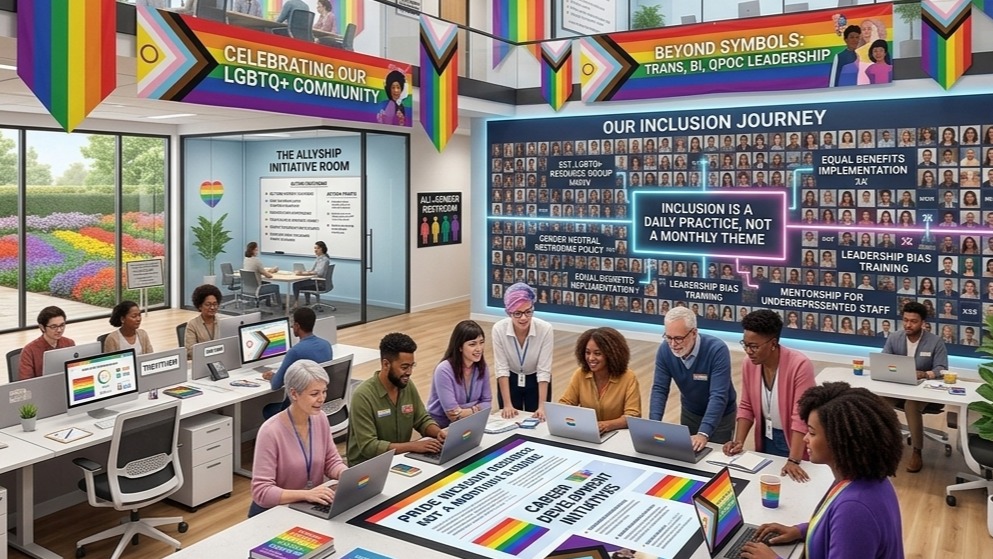
A major flashpoint for rainbow washing occurs when a brand publicly champions inclusivity while lacking internal frameworks like equal medical benefits for same-sex partners, inclusive HR policies, or diversity in leadership. Industry experts agree that true allyship must begin inside the company walls before a single marketing asset is produced.
Sini Magon, COO & Partner at Grapes Worldwide, notes that today’s hyper-connected consumers possess a clear view of corporate behaviour. “People today have a much clearer view of how brands behave around the world,” Magon states. She emphasises that if a company is vocal about inclusion in one space but completely avoids the conversation internally or in other areas, those inconsistencies do not go unnoticed. For Magon, the brands that earn respect are those that stay true to their principles and remain consistent in their behaviours.
Poulomi Roy, CMO of Joy Personal Care (RSH Global), points to a growing consumer fatigue stemming directly from this lack of authenticity. “Too many brands treat Pride as a campaign rather than a commitment,” Poulomi asserts. “Consumers today can easily distinguish between brands that genuinely stand for inclusion and those that engage with it only when it is visible or fashionable.”
Shifting the focus to structural interventions, Sonica Aron, Founder & Managing Partner of Marching Sheep, expresses frustration with organizations that treat the actual content of diversity interventions as an afterthought while obsessing over static creatives and video reels. “What are you celebrating if people continue to remain closeted? What is the point of awareness sessions if we do not measure application?” Aron asks. She advises that before launching any Pride campaign, companies must ask a fundamental question: “If an LGBTQIA+ employee were evaluating our workplace based on their experience of being in it, as opposed to marketing materials, would they feel included, respected, and supported?” According to Aron, an inclusive workplace is experienced through real policies, manager sensitisation on pronouns and inclusive language, robust reporting mechanisms, and queer representation at the leadership table.
Adding a communications and public relations perspective, Juhi Seernani, Senior PR Associate at Opraah, aligns with this inside-out approach. “Authentic Pride communication should be a reflection of a company’s culture, not a substitute for it,” Seernani outlines. She notes that today’s highly informed consumers can quickly spot structural gaps. For a campaign to hold any weight, brands must assess if inclusivity genuinely exists beyond marketing—evaluating equitable benefits, inclusive hiring, and ongoing diversity training first. “The most credible Pride campaigns are built on actions that already exist internally. When inclusivity is embedded into the workplace throughout the year, external storytelling becomes far more genuine, impactful, and sustainable.”
Providing a tangible corporate blueprint, Parmesh Shahani, Head of the Godrej DEI Lab and author of Queeristan, shares how internal progress fuels authentic external celebration. “At Godrej Industries, internal policies were expanded as early as the late 2000s to cover diverse families, including medical benefits for same-sex partners. Today, the group employs over 300 out LGBTQIA+ individuals full-time.
Many of our companies have established internships to welcome and mentor LGBTQIA+ people; we work hard to make allyship and inclusive behavior part of how we work and all our senior leaders have clear inclusion targets on their goal sheets. This year-round foundational work is what makes their annual Godrej One Pride March authentic. A Pride campaign can end with rainbow cupcakes and glitter, but it needs to start with hard, meaningful work to invite queer people into your workplace, aligning their success with the success of your business,” Shahani explains.
Building a 365-day roadmap
The sudden disappearance of LGBTQ+ advocacy from corporate calendars on July 1st has led to deep consumer cynicism. Transitioning from seasonal marketing to an authentic, year-round corporate roadmap requires a fundamental shift in business strategy.
For Magon, consistency remains the primary metric of brand credibility. She reiterates that inclusion cannot be an operational switch that brands flip on and off based on convenience. Consumers notice these temporal inconsistencies quickly, and long-term brand respect is reserved solely for organisations that maintain their core values consistently across their operational calendar.
At Joy Personal Care, Roy explains that true representation should be integrated naturally into everyday narratives rather than tied to a specific marketing window. She highlights their mainstream campaign featuring prominent queer figure Sushant Divgikr, which was intentionally launched outside of Pride Month. Similarly, during the height of COVID-19, the brand proactively supported transgender communities in Bengal based strictly on human need, completely detached from any marketing agenda. “Inclusion cannot begin in June and end in July,” she states, advocating for ongoing, year-round visibility across all communication streams.
Aron highlights that because employees and consumers share the same social ecosystem, consumers easily spot corporate misalignment. She notes that authentic allyship cannot operate on a basic yearly calendar; it must be embedded into the entire framework of a business strategy—encompassing inclusive hiring, benefits equity, Employee Resource Groups (ERGs), continuous sensitization training, and supplier diversity. Aron also points out that some of Marching Sheep’s most intentional clients rarely post their initiatives on social media, choosing instead to focus on unglamorous but vital basics like driving behavioral changes during job interviews, team appraisals, and incremental infrastructural updates.
Seernani emphasises that long-term allyship requires steady consistency rather than loud visibility compressed into a single month. To bridge this gap, she believes a sustainable 365-day corporate roadmap should look behind the scenes, integrating year-round mentorship initiatives, community partnerships, and continued investment in LGBTQ+ voices across mainstream campaign pipelines and executive leadership dialogues. “Brands should view Pride as one chapter in a larger commitment rather than the entirety of it,” Seernani maintains. “When support remains consistent beyond key calendar moments, audiences begin to see inclusion as part of a brand’s identity rather than a seasonal marketing exercise.”
Expanding on year-round activation, Shahani demonstrates how Godrej translates inclusion into real-world products and mainstream narratives. For instance, Godrej Capital became one of the first Indian financial institutions to introduce a housing loan product specifically designed for same-sex couples. Additionally, Godrej Consumer Products recently launched a new factory in Tamil Nadu with a mandated 5% representation of LGBTQIA+ and PwD talent from day one. Over the past three years, the group has also broadcasted inclusive Diwali commercials centered on the progressive philosophy that relationships are defined by love and belonging rather than rigid traditions. Beyond commercial operations, their Godrej DEI Lab continually builds public resources, hosts the India Included podcast, and runs campus-wide inclusion case study challenges for MBA students to keep diversity at the forefront of future business leadership.
Moving past tokenism
Tokenism frequently commercialises queer aesthetics through generic, mass-produced corporate merchandise without providing actual economic backing to the community. Industry leaders are urging brands to structurally redirect their ad spend and design pipelines to actively employ and fund LGBTQ+ creators, entrepreneurs, and businesses.
Magon points out that while operating across different market segments introduces distinct commercial expectations, consumers quickly notice when a brand hesitates to back its values financially or structurally. She emphasises that trust is built when a brand’s spending, vendor selection, and actions directly line up with its public diversity statements.
Roy advocates for a shift where representation is strictly accompanied by active participation and financial opportunity. “Brands can contribute by collaborating with LGBTQIA+ creators, artists, entrepreneurs, and professionals,” she notes, emphasizing that members of the community must be integrated into the actual creative and business ecosystems operating behind the scenes, ensuring they profit directly from the campaigns they inspire.
Aron views this stage as a critical transition from simple representation to authentic participation. She challenges brands to audit their financial pipelines: “Who is actually financially benefiting from that promotion? Instead of merely hiring queer people and paying them on a per-project basis for June, organisations can begin to integrate queer talent into the everyday fabric of their business.” Aron suggests commissioning queer artists and illustrators, onboarding queer-owned businesses into supplier and vendor networks, and providing professional mentorship and skill-building pipelines. She warns that if brands continue to profit from queer culture without financially contributing back to the community, consumers will lose all reason to believe their messaging.
Shahani highlights how the Godrej DEI Lab addresses this through targeted financial and cultural investments. The lab actively participates in The Pride Fund India, a philanthropic fund supporting grassroots non-profits working directly within queer communities. Furthermore, they collaborate with publisher Westland Books on Queer Directions, an imprint dedicated to supporting and expanding LGBTQ+ literature and thought in India. They have also launched the Queer India Fellowship to explicitly move young queer individuals into systemic leadership roles. “The broad takeaway is that we believe you have to invest in queer people, to fund our ideas, and to create pathways of consistent mentorship and support,” Shahani summarises.
Navigating regional sensitivities without compromising values
A significant corporate contradiction occurs when multinational corporations launch vibrant Pride initiatives in progressive urban centers while completely scrubbing advocacy or remaining silent in culturally conservative regions. Balancing local cultural nuances with a universal commitment to human dignity is a complex but necessary challenge.
Magon acknowledges that while different environments require distinct communication approaches, the core intent behind a brand’s actions must remain immovable. “I’ve seen brands get this wrong when they only show up for inclusion where it’s easy or safe,” Magon states. “If you believe in something, you figure out how to show up with sensitivity and respect, not pull back completely. It’s not about being loud everywhere. It’s about being real, being consistent, and backing your values, even when it’s not the popular choice.”
Echoing this sentiment, Roy views inclusion as a universal human necessity rather than a regional trend. “While the way brands communicate may differ across markets and cultural contexts, the underlying commitment to inclusion should not change,” she comments. Brands can thoughtfully adapt their communication to align with local sensitivities, but they must never lose sight of the broader foundational principles of acceptance, dignity, and authentic representation.
Aron categorises this pitfall as treating inclusion as a superficial communications decision rather than an uncompromisable values decision. When equity is truly anchored in organisational values, public positioning gives way to corporate consistency. While context and cultural nuances matter—meaning campaigns do not need to look identical globally—the underlying commitment to employee safety, dignity, and equal opportunity must remain uniform. Aron observes that employees quickly spot global hypocrisy, and a brand’s moral clarity is tested by how it protects and respects individuals in every geography, not just comfortable ones.
Building heavily on this pivot, Seernani states that the conversation must definitively pivot from visual representation to structural participation. Instead of simply borrowing artistic and visual cues associated with the Pride flag, she urges brands to divert capital to minority-owned partners across the entire campaign lifecycle. Seernani’s recommended action steps include commissioning queer designers, hiring LGBTQ+-owned creative agencies, assigning media budgets directly to queer digital creators, and prioritising sustainable, multi-year vendor partnerships over transactional, one-off engagements. “Economic inclusion creates measurable impact and ensures that the people whose stories are being celebrated are also benefiting from the opportunities being created,” Seernani explains.
Shahani challenges the notion that progressive values belong strictly to urban centers. Drawing from historical social movements, he believes businesses must hold up a mirror to society to foster a more open and accommodating world. He reflects on Godrej’s widely viewed Diwali commercials, noting that their progressive narratives on familial acceptance resonate across a massive, diverse Indian audience rather than a narrow urban sliver. The opportunity for brands lies in celebrating universal themes of human acceptance, belonging, and mutual understanding across all regions.
Beyond the billboard
The message from industry experts, advocates, and modern consumers is undeniable: the era of symbolic, rainbow-themed corporate gestures is drawing to a close. Visibility and representation remain vital milestones, but their lasting impact is entirely dependent on the structural realities engineered behind the scenes.
For a brand to achieve true credibility, inclusion can no longer be treated as a seasonal marketing campaign or a regional trend. It must be woven directly into the daily fabric of corporate operations, reflected in inclusive HR policies, robust partner benefits, equitable vendor pipelines, year-round storytelling, and active financial investment in queer talent. Ultimately, authentic allyship is not defined by changing a corporate logo for thirty days in June; it is defined by how a business operates, empowers, and respects the community every single day of the year.