
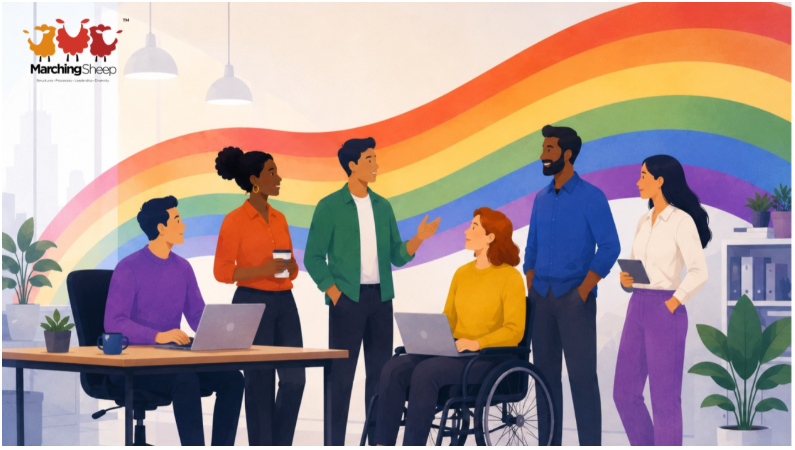
The last few days we have had multiple conversations on ‘Celebrating’ Pride month. Panel discussions and fireside chats are scheduled, Calendars blocked, rainbow filters are applied to branded assets, and guest speakers are invited to share their journey.
Inclusive emails are being drafted and CEOs and CHROs are launching them. There is an atmosphere of leaving a mark and creating visibility around the events. Once in a while, someone asks, we have done this all before without impact, tell us something unique, to create awareness as well as engagement.
Soon 30 days shall pass and it will be 1st July
And nothing would have changed.
Here is the uncomfortable truth most organisations are not willing to sit with: awareness is not inclusion. A talk about LGBTQIA+ experiences doesn’t make your team meetings safer, and a panel on Pride doesn’t change what happens when an employee makes a casual joke at someone’s expense and their manager laughs along. Policies exist in handbooks, but behaviour plays out in hallways, in team meetings, in the silence after a joke that nobody challenges.
The Gap Between the Policy and the Corridor
Most organisations I work with have the policies and infrastructure in place: equal opportunity statements, gender-neutral restrooms, inclusive medical insurance and DEI charters that explicitly include sexual orientation and gender identity. Some have gone further, with Employee or Business Resource groups, inclusive benefits, and mental health support.
And yet, when asked, how many people in the organisation feel safe to self-disclose and be their authentic selves, there is an awkward silence, followed by righteous justification- we don’t ask.
LGBTQIA+ employees in these same organisations tell a different story. They still self-censor. They decide, every single day, how much of themselves is safe to bring to work. They calculate, often unconsciously, whether to mention their partner at the team lunch, whether to correct a colleague who uses the wrong pronoun, whether to raise their hand in the town hall or stay quiet and stay safe. They experience the behaviour around them, and the policy that didn’t translate into safety.
Inclusion Is a Daily Referendum
What I want today’s leaders to genuinely grapple with is this: inclusion is not decided in the boardroom or the policy document or in that one event. It is decided in a hundred small moments every single day. The way a manager responds when someone comes out, the way a team reacts to an off-colour joke, the way a performance review is written when the reviewer is uncomfortable with who the person is, the way the term “culture fit” gets used to keep certain people out.
What makes these moments so hard to address is that they are often unintentional and unreported. They don’t surface in formal grievance processes, and precisely because they are small, they are normalised and allowed to accumulate until the LGBTQIA+ employee quietly decides that this organisation is not a place where they can thrive, and either leaves or dims their light to survive.
Awareness campaigns don’t address this. Behaviour change does.
What Do we Actually Need to Do
Shifting behaviour is harder than scheduling a panel, and it requires organisations to be honest about where those behaviors actually are.
Let’s start with managers. They are the single biggest contributor to whether inclusion is real or performative. An LGBTQIA+ inclusive policy means very little if the manager of that team creates an environment where people don’t feel safe, seen, heard or respected. And Manager capability-building is not a one-hour sensitivity training or an e-module, but a sustained journey with practical conversations about inclusive team culture and Psychological safety.
Next, Examine norms, not just policies. What language is tolerated in team chats? What happens when someone raises a concern? Is psychological safety strong enough that an employee can tell a senior colleague their comment landed badly and be heard rather than sidelined? These are not policy questions but culture questions, and culture is shaped most powerfully by leaders.
Third, Allyship is a verb. It requires intentional action. An ally is not someone who agrees that discrimination is wrong but someone who speaks up when discrimination is observed, experienced or perpetuated. Allyship needs to be nurtured and rewarded.
Lastly, lets listen. Not in a focus group that produces a report that sits in a folder, but in a way that leads to real change. Listen to the unexpressed hesitation, the quiet turning down of an invitation to an office party, the demotivated voice after an inappropriate joke is made. Hear what your organisation actually feels like from where your LGBTQIA+ employees sit, and then act on what we hear.
Pride Is a Beginning, Not a Destination
June is a good time to signal intent, but signals without follow-through create cynicism, and cynicism transforms into lack of belonging.
The organisations that get this right are not the ones with the most visible Pride campaigns. They are the ones where an LGBTQIA+ employee can mention their partner over lunch and nobody makes it awkward, where a manager notices a microaggression and addresses it in the moment, where inclusion is so embedded in everyday behaviour that it doesn’t need a month to announce itself.
That is the standard worth holding your organisation to.
Article by Sonica Aron, Founder & CEO, Marching Sheep.