
The world of work is not changing incrementally anymore. It is being fundamentally rewritten.
Over the last few years, organisations have dealt with pandemic aftershocks, economic uncertainty, geopolitical conflicts, inflationary pressures, AI disruption, changing workforce expectations, and rapidly evolving business models — all at the same time.
And yet, many organisations are still responding with yesterday’s structures, yesterday’s leadership models, and yesterday’s HR playbooks. The reality is this:
The biggest risk facing organisations today is not AI. It is organisational inertia.
Across industries — banking, automotive, FMCG, pharma, infrastructure, IT, GCCs — I am seeing the same themes emerge repeatedly.
AI is reshaping jobs faster than organisations can redesign roles.
Middle management layers are slowing down decision-making instead of enabling agility.
Burnout is becoming institutionalised in “always-on” cultures.
Leaders are struggling to navigate ambiguity and sustained uncertainty.
Skills are becoming obsolete faster than companies can reskill their workforce.
And geopolitical instability is creating unpredictability in supply chains, hiring sentiment, investment priorities, and business continuity planning.
This is not a temporary disruption. This is the new operating environment.
The organisations that will succeed over the next five years are unlikely to simply be the largest or most profitable today. They will be the organisations that:
- learn fastest
- adapt fastest
- reskill fastest
- simplify fastest
- combine technology and human capability most effectively
Which brings me to a critical question:
What should CHROs be doing in the next 3–6 months?
It is no longer about long drawn Annual Operating plans, 5 year plans, or elaborate transformation agendas.
It is about immediate, business-critical action rooted in people structure, capability and wellbeing.
Here are five priorities every CHRO should urgently focus on :
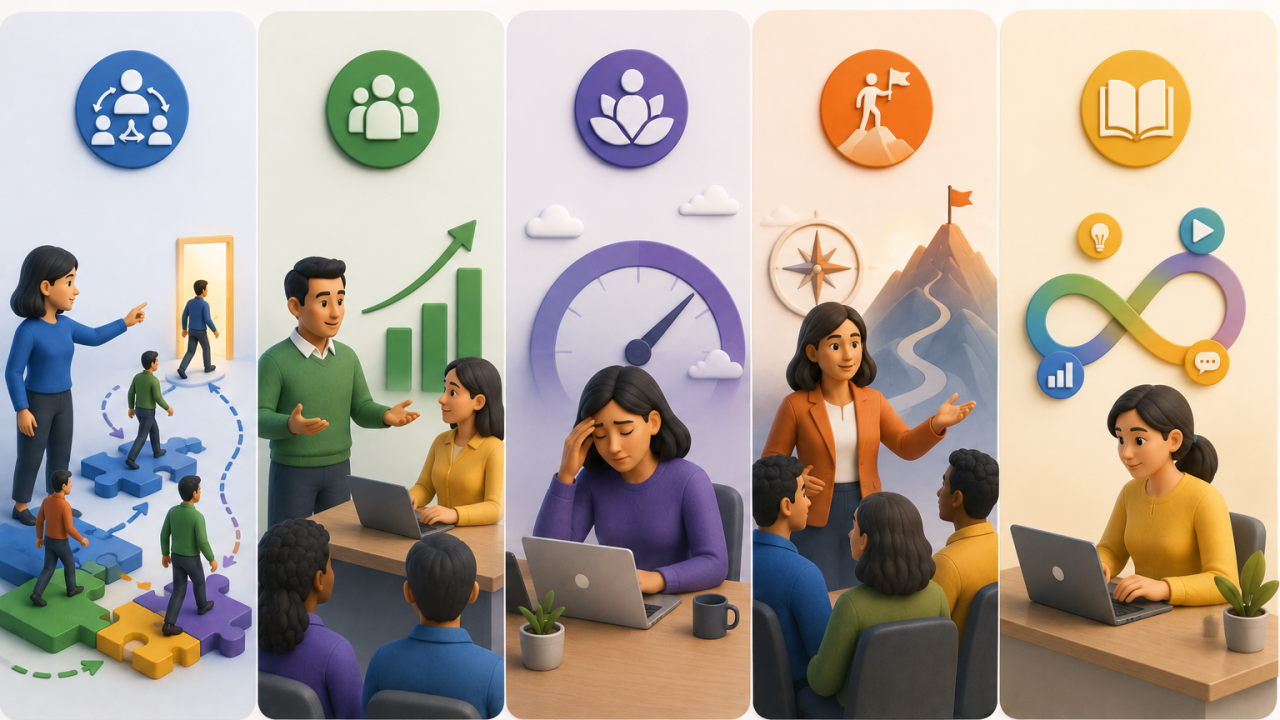
1. Figure out workforce redeployment in your context.
Many organisations are still thinking in terms of hiring versus layoffs. The smarter organisations are thinking about redeployment.
AI will eliminate tasks, no doubt about it. The question is: Can companies identify higher order skills, capabilities and capacity quickly enough to redeploy talent into emerging roles?
CHROs need real-time visibility into:
- Critical future roles and skills
- Redundant tasks
- Redeployment opportunities
- Internal mobility pathways
The future belongs to organisations that can reskill at scale and do not get caught into the recruitment and layoff loop.
2. Rebuild middle management capability
One of the biggest hidden organisational risks today is the Management middle layer.
Many managers who were successful in stable environments but are now struggling with:
- Ambiguity
- Speed of change
- cross-functional collaboration
- AI-led ways of working
- multi-generational workforce expectations
The expectation from a managerial role has shifted significantly.
Today we need managers who can:
- Coach
- Influence
- Simplify
- Empower
- Problem solve
The middle layer can either become the greatest accelerator of transformation — or the biggest blocker.
3. Treat burnout as a business risk, not a wellness initiative
Emotional fatigue is everywhere, irrespective of industry, function or hierarchy.
Employees are dealing with:
- Constant change
- Economic anxiety
- Digital & Content overload
- Blurred work-life boundaries
- Continuous performance pressure
- Job insecurity
Many organisations are unknowingly creating cultures of silent exhaustion with burnout eroding away at productivity, innovation, customer experience, retention, leadership pipeline quality
This requires cultural and structural re-orientation with embedding of wellbeing across processes and policies.
CHROs must examine:
- Unrealistic and unequitable workloads
- Decision bottlenecks
- Meeting overload
- Lack of recovery periods
- Toxic responsiveness culture
4. Build leadership capability for uncertainty
Most leadership frameworks were designed for predictable environments.
But today’s leaders must operate amidst:
- AI disruption
- Geopolitical volatility
- Social polarisation
- Changing workforce expectations
- Economic unpredictability
Technical and functional competence alone is no longer enough.
Future-ready leaders need to flexible, emotionally intelligent and resilient, strong authentic communicators who truly inspire, and Manage change with empathy.
The real leadership differentiator today is the ability to create transparency amidst chaos, safety amidst ambiguity.
5. Create a culture of continuous learning — not episodic training
The half-life of skills is shrinking dramatically. A degree earned five years ago is no longer enough. Even technical skills now become outdated rapidly. Learning can no longer sit inside LMS platforms waiting for employees to “complete modules.”
Learning must become embedded into the rhythm of work itself.
The organisations that survive disruption will not necessarily be the ones with the best talent today. They will be the ones that can continuously transform their talent.
HR and L&D can no longer remain an execution-focused support function. They must act as business strategist, workforce architect, transformation catalyst, organisational conscience keeper and business performance drivers through people.
This evolution is here to stay and is demanding. Which leaders, and organisation ride the wave, and which ones drown will depend significantly on whether HR chooses to lead transformation through the above outlined focus areas.