
Every consultant knows the ritual.
You finish a leadership program, a DEI intervention, a strategy workshop, or a culture transformation assignment.
Soon after, a polite email goes out:
“Please share the participant feedback scores.”
Then comes the familiar evaluation grid:
• Was the facilitator engaging? • Was the content relevant? • Was the session interactive? • Would you recommend this consultant to others?
Consultants across the world have accepted this feedback ritual with grace.
But every once in a while, a mischievous thought crosses the mind:
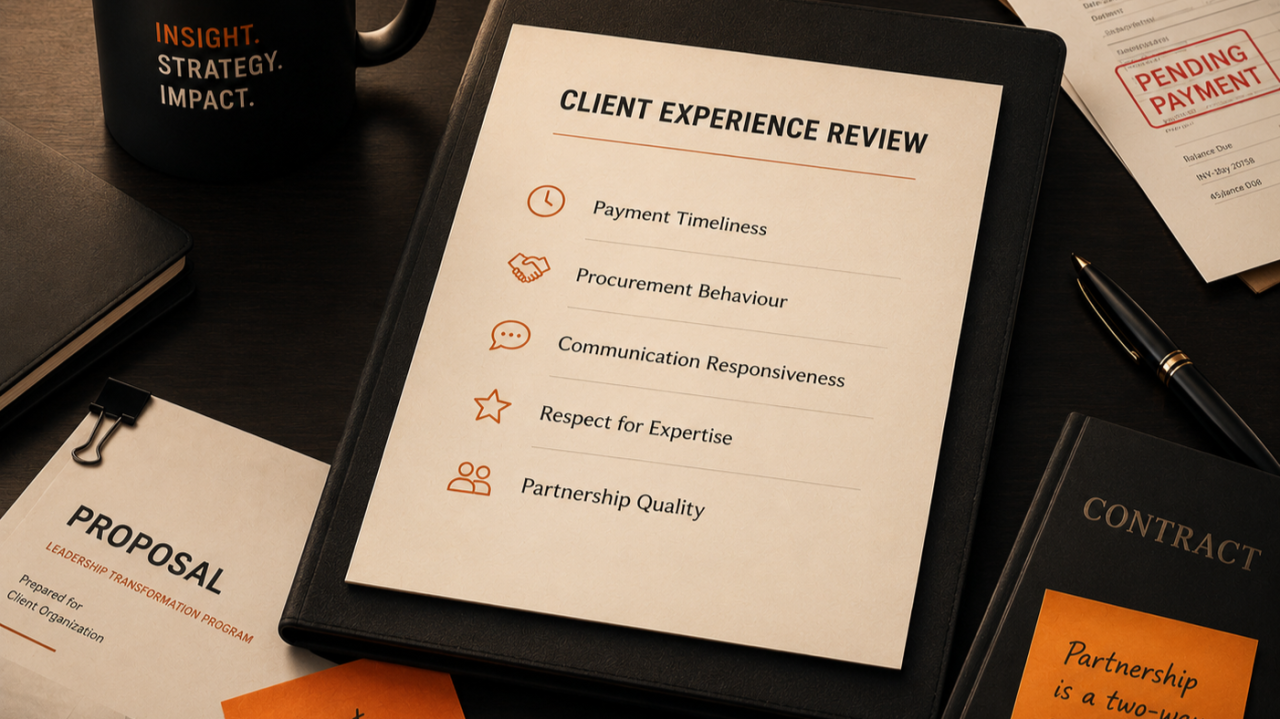
What if consultants also collected feedback on clients?
Imagine receiving a post-project survey that said:
“Dear Consultant, before we close the assignment, please rate your experience working with this client organization.”
The questions might look something like this.
1. Payment Timeliness
How efficiently did the client process payment?
- ⭐⭐⭐⭐⭐ Payment arrived before the reminder email was even drafted. (Mythical creature.)
- ⭐⭐⭐⭐ Paid within the contracted 30 days.
- ⭐⭐⭐ Required two polite reminders and a gentle nudge to accounts.
- ⭐⭐ Payment released after three months and twelve follow-ups.
- ⭐ “Invoice approved but stuck in the system since last quarter.”
Most consultants will tell you this truth:
Delivering a three-day leadership transformation program is often easier than navigating a three-month payment cycle.
2. Procurement Negotiation Style
How did the procurement team approach commercial discussions?
- Strategic partner mindset – Focused on outcomes and value.
- Tough but fair – Healthy negotiation, mutual respect.
- Vegetable market mode – “If you can do it for 5 lakh, why not 3?”
- Forensic audit mode – Every cost line examined like a crime investigation.
Consultants understand budgets.
What they occasionally struggle with is explaining intellectual capital as if it were a bulk commodity.
“Can you reduce the price if we remove the thinking part?”
3. Proposal Ghosting Index
How responsive was the client after requesting a detailed proposal?
- Highly engaged – Thoughtful conversations, clear decisions.
- Polite delay – Occasional updates while internal alignment happens.
- Meditative silence – Weeks of calm, reflective non-communication.
- Complete disappearance – Last seen requesting a 15-page customized proposal with case studies.
And then one day, while scrolling LinkedIn, you see it:
The exact framework you proposed… now running internally at the client organization.
Pure coincidence, of course.
Consultants are generous people.
4. Respect for Expertise
How was the consultant positioned in the engagement?
- Trusted advisor – Invited into real conversations.
- Professional partner – Clear scope, mutual respect.
- Slide beautification expert – “Can you just make this look nicer?”
- Emergency firefighter – Called after six months of internal confusion.
Here’s the irony.
Organizations say they want strategic partners.
But sometimes treat them like first aid providers.
5. Post-Project Memory Retention
What happened after the work was done?
- Outcomes acknowledged.
- Impact celebrated.
- Testimonials shared.
Or…
The consultant mysteriously disappears from organizational memory until the next crisis arrives.
Now, of course, this feedback form will never actually exist.
Consulting runs on relationships. Diplomacy is part of the profession.
But the thought experiment raises an important question.
If organizations want true partnerships, shouldn’t accountability go both ways?
Timely payment isn’t generosity. It’s honoring a contract.
Respectful negotiation isn’t courtesy. It’s good business.
And intellectual work deserves the same ethical treatment as any other professional service.
To be fair, many clients are fantastic partners who value expertise and build long-term relationships.
But perhaps the consulting ecosystem needs a small cultural shift, where partnership is not just a word used in kick off meetings…but something that shows up in behavior.
Until then, consultants will continue doing what they do best:
Delivering powerful programs…and gently checking whether Accounts Payable has returned from their extended spiritual retreat.